Monday, July 20, 2009

Read all about it

I read four good books during my first three weeks in India.

Fast Food Nation
Eric Schlosser


Quick Review: Another hard hitting but insightful investigative journalism work by Eric Schlosser (see also: Reefer Madness). In true Schlosser fashion, the book takes hard swipes at the mistreatment of immirgrant workers, antiunion habits of corporations, powerful lobbiest groups (here the big Meatpacking companies), and the commodification and over reliance on technology supposedly running rampant in today's America. The book ends with only weak suggestions for solutions and a somewhat hypercritical afterword, but the heart of the book is grade A.

Relation to Iowa: Alot of the horror stories of meat packers and slaughter houses gone wrong come straight out of Iowa. Council Bluffs and Denison are both mentioned (one CB worker died falling into a renderer/grinder and a Denison guy lost his arm -if I can remember correctly?)

Relation to India: I've had maybe five meals with meat since landing in Delhi a month ago, three of those were at the Jaipur McDonalds. Even though I finished the book the weekend we were in Jaipur, even though I was fully repulsed by how embedded most Americans' fast food addiction has become, and even though the true scope of how un-foodlike modern fast and junk food has become, I STILL, without hesitation, ate three of my five meals in Jaipur at McDonalds, the only one I've seen while in India. While mulling over how industrial (Schlosser would say unnatural) and fake our food has become (artificial and natural flavors are simple lab chemicals that give food its flavor- in everything!), it helps to be on a steady diet of fresh veg Indian food. Really can't wait to get back to burgers in August.


Einstein
Walter Isaacson


Quick Review: The first big real biography I've ever fully read and a good un for sure. Isaacson paints an interesting picture of an interesting man: a person with a mind good for both revolutionizing science and helping to escape the lifey troubles all people have to cope, a man who embraced his celebrity and cared for all of humanity but was distant to those meant to be closest to him. Smoothly glides between biography, science writing, and narrative to create a great read about a guy you only wish you could've met.

Relation to Iowa: Book mentions Iowa City when talking about one of Einstein's travels through the states while looking for a job.

Relation to India: I'd like to think that, at least while in India, I've taken up some of Einsteins personal fashion methods. In his latter years, the aloof nature of his mismatched clothes helped reemphasize his whole absent minded professor-ness and some believe that without his famously unkept hair, he never would have reached the level of celebrity he did. As I planned to do laundry only once this trip (you have to hand wash everything), I've had to get creative with my outfit selection these last few weeks. And who knows? With everyone here trying to dress Western, maybe I'll start a new trend by going around in my brightly colored tees and maroon athletic shorts. (Actual quote: "Your fashion, it is looking the best. Yes.") I've worn my swimming suit out and about on multiple occasions and haven't gotten a haircut in three months; though I'll probably take up one of the street barbers' Rs.30 ($0.66) offers soon.


The Undercover Economist
by Tim Hartford


Quick Review: A quick pop econ book that covers about 70% of econ 101's most basic fundamentals and manages to use nearly 0% of the associated jargon. Pretty good everyday illustrations of a wide variety of concepts. The book goes along with us as we buy overpriced coffee from a stand, search for good prices at the supermarket, and surf the web on our phones.

Relation to Iowa: "There are two ways we can make cars in America. We can build them in Detroit or grow them in Iowa... in Iowa we simply water corn seeds and harvest a crop, load it onto an ocean vessel and send it out into the sea. It will return to us as cars using an amazing corn-to-cars technology called Japan." The book uses the state in any example involving agriculture. Yay Iowa!

Relation to India: Has some interesting stories about traveling to the Cameroon. Has some typical ideas about spurring development in places like Cameroon. Tells a very rich story about China's historic economic turn around. Good lessons on both stagnant growth and rapidly developing nations which can be applied (and seen) right here in India.



We Wish to Inform You That Tomorrow We Will be Killed With Our Families
by Peter Gourevitch


Quick Review: The saddest story I've ever read, but probably only because it all actually happened. Peter Gourevitch's recounted survivor stories from post-genocide Rwanda tell of a country desolated by harsh colonial rule followed by harsh dictatorships and rocked by an ethnic slaughter resulting in about an eighth of the population being killed, most commonly by way of machette. The book gives a reliable account of the history, before and after colonialization, of Rwanda and the more recent events preceding the 1994 Tutsi genocide. Gourevitch remains objective when berating the international aid networks and organizations (for ignoring the details of the situation and accidentally giving aid for years after the genocide to the killers and political leaders responsible) and the so called developed world, which vowed after WWII to never again let an ethnicity be cleansed, (for turning a blind eye during and after the genocide). The author is superbly introspective, especially when interrpreting the accounts of his informants. There is more to this tragic story than I can do justice explaining here, so just Wikipedia it or get the book.

Relation to Iowa: Only book that doesn't really mention Iowa. Not even once, go figure.

Relation to India: When Peter Gourevitch writes on the intricacies of visiting Rwanda, a nation with visible ties to its colonial past and a great many seriously impoverished people, I feel like he is writing about India. Almost. Although India has a somewhat corrupt police force and its people (at least outside of Mumbai and Goa) often act as if in awe when spotting a foreigner, there isn't really any remaining signs of India's inner country post colonial struggles (Pakistani partition in 1947 turned those into good old fashioned international hostilities). Also unlike in India, Rwanda suffers a dearth of foreign investment and economic growth, whereas Indians become gloomy when news spreads that their economy may only grow by six or seven percent this year due to the recession (taken into the context of human history anything over five can be considered extraordinary). Reading We Wish to Inform You.. makes it sound as if there is another planet I've yet to see: not just the (1)cozy or (2)growing, but the third. Better reserve the gonetorwanda-brb.blogspot.com url now just in case.

Thursday, July 16, 2009

Kanjar

Thousands of years before the arrival of the British, the lush Indian subcontinent provided the setting for the independent discovery of agriculture and the birth of Indian civilization. Hinduism was founded, the caste system was implemented, and a culture was created. It is unclear (to me at least) whom predates whom, but a nomadic foraging sub group society, today known as the Kanjar, coexisted alongside and within this early India.

The Kanjar, existing outside of the rigid caste system subscribed to by greater Indian society, maintained their nomadic traditions well into the twentieth century. Precolonialism, their interaction with mainstream Indian society mainly consisted of part time work as entertainers and performers. With the strengthening of British influence in the mid 1700's, a bevy of modernization and imperialistic exploitation projects began slowly destroying the jungles and forests the foraging Kanjars depended. Taking action, the Kanjar resorted to rebellion and crime against their foreign guests; though again, it is not clear as to what direct total affect the British had on the decision to turn towards crime and what affect being generally outcast in an increasingly British-like India had.

In either case, the British criminalized by decree the entire Kanjar clan in 1857. Three years later, the Kanjar were scheduled by name under the British Criminal Tribe Act. An apparent attempt into pushing the various pesky tribes around India into shaping up, the 1860 Act had the rather unfortunate unintended consequence of forever stigmatizing the Kanjar within India; synonomizing even today their very tribal identity with criminal or felonious or immoral. It is the descendants of these eternally shamed persons whom I have the responsibility to teach the ABC's and 123's over the summer.

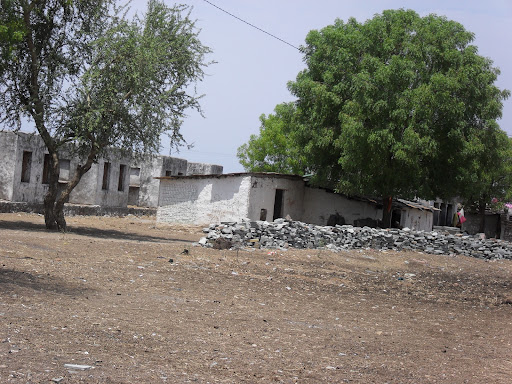
Our first day in Jhalrapatan was reserved for visiting two Kanjar villages and the schools we could choose to teach. The villages are similar to the ones seen on late night Christian infomercials urging viewers to 'save the lives of these children, for under a dollar a day'. Each village consists of around 80 people, ~30 of them school aged children (though education is by no means a priority); and a few dry (unirrigated) farm plots surrounding a few dozen brick rock homes. The houses are the families' bedrooms and living rooms, filled with little more than a few pots and beds. There are no evangelists or infomercial camera crews in either village.

As India's population ballooned after its 1947 independence from Britain (kudos, Gandhi) and land became an asset, the Kanjar were forced to end their nomadic ways and settle on government owned reservations. The Kanjar of today (popularly known under the umbrella term 'Untouchables' in the West) are a marginalized people, heavily discriminated against by law enforcement. Their remote locations offer isolation from the often corrupt police force, but (coupled with an understandable aversion to the authority of the state) also removes them from many mainstream government services. India is the world's largest democracy, but the Kanjar have no political lobby to protect their interests and are usually a minority even within their own districts (remember that the UNICEF Kanjar programs were abolished a few years ago to rid the state minister the shame of having aid programs in Rajasthan under her tenure) and so carry little political weight.


That doesn't mean they are desperately poor and suffering, however. On our tours, I counted many motorcycles parked next to brush or rock piles, at least one satellite TV, and heard music from a variety of cell phone and stereo speakers. I believe each resident is entitled to some form of annual government welfare, but I can never get a straight answer as to how much, or if any, is handed out. The other main sources of income for the Kanjar include 'selling' their daughters into marriage (a practice translated by the IDEX staff into the not-quite-correct-sounding "prostitution") and illegally brewing an alcoholic drank for retail out of berries (more on this later).

All in all, the villages were not in as desperate shape as I'd imagined, though certainly not a place high on the property ladder. With their one room school houses, the nonchalant attitude towards education (especially when it gets in the way of cooking or farming duties), the use of homemade booze, the conservative approach to women's rights, and their interesting farming techs (I had only seen ox drawn plows in museums before), the villages always seem to remind me of predepression Iowa. The high rates of alcoholism and welfare dependence, general state of their isolated government property communities, and low formal employment masquerading greater discrimination and a long history of marginalization make the Kanjar communities a slightly familiar but altogether different kind of Indian reservation than I'm used to.

Camp Jhalrapatan and TV India

We took a Bolero (imitation land rover) from the train station to our house. The ~30km (18 mile) journey took about half an hour due to narrowness of the highway, congestion, lack of street lights, animals and people walking on the streets, and it being generally difficult to navigate a large vehicle through cramped Indian cities at any time, let alone during the busy and dark night shopping period. Along the way and throughout many of the smaller cities scattered along the Rajasthani highways, large crowds of people could be seen gathering around single 22" TVs - what these groups tune into en masse I can only guess.


We reached our house at around 10pm, where our in house cook, translator, guide, and soon to be teaching assistant, Saroji had a large hot dinner waiting. A mother of two (who refused to marry her daughters off until after they had completed a full education), Saroji is self described 'brave woman' -- meaning she is more independent than your average forty something Rajasthani woman ("but not as wishful to be independent as your women of the West"). Accompanying us everyday to class, occasionally team teaching in our village, she never hesitates to bargain or defend on our behalf. As we passed through our front yard gate that first night, Saroji was there to greet us and adorn a traditional red paint dot on our foreheads (which normally signifies marriage but forehead marking can be symbolic for a great variety of other things; perhaps ours was a sort of welcoming wish). Sohan looked visibly happy to be settled back at camp Jhalrapatan.

Saroji's cooking is perhaps the single greatest discovery I've made while in India. Using only fresh ingredients (and you can't get much fresher than locally bought vegetables grown on locally owned and dry-farmed family agro plots), her dinner entrees usually consist of potatoes or okra or ladyfingers covered in various Indian (curry) spices and oils, served aside butter flavored white rice (usually with potatoes or tomatoes), cut fresh vegetables, and a bean and spices soup or two. And with chapati (or naan, but I prefer to call them tortillas). Always with chapati. A lot of it.

Breakfasts are usually some mix of bananas, toast, hard boiled eggs, or japarti stuffed with either potatoes or simply more japarti dough. Meat is never a part of the equation, though she does fry a delicious mixture of vegetables and uniquely savory dough into bite sized morsels with the texture and look of chicken strips. Cheese is a rarity but milk and plain yogurt are not. Soda is relatively expensive (which is to say pop here is priced on par with Walmart back home) and fruit juice is downright extortionate (along with toilet paper, artificial and fruit juices are strangely 'overpriced' -- probably due to some mixture of low demand/low production possibility?) but the food is usually flavorful enough that an old fashioned glass of filtered water is well enough for most days' in-meal beverage.

The house is not air conditioned, instead relying on ceiling and stand fans. Our room does have a water cooler, a sort of humidifyier that uses only cold water and a very big and noisy fan (it says "Snow Cool" on its side), which we're told is actually more effective here than air conditioning. It spends most nights unused because it causes too much cold water to condense on our sheets. There are two lounge spaces with great views on the third story. At night, it provides the best escape from the heat the house traps in its rooms during the day. The view is great and you can often see the celebratory Christmas lights hanging on far off houses (marking a family wedding) or hear Hindi DJs drop beats in the streets for neighborhood dance parties.


We have a high speed internet connection here too which I use to write retroactively on this blog and stay up to date on Facebook (because knowing that the new Harry Potter was 'SUUch a waste of my time' or 'AHHH bestie movie ever' is essential to living a fully satisfied life in India). And while the power (and sometimes water) is shotty, especially during storms and the hottest part of the day, we also have a TV with +70 cable channels.

While tradition still tells women it is inappropriate to show their bare shoulders in public, Indian TV tells us the best way to get the ladies to rip off their clothes is to use Axe. Commercials often fall into one of three categories: actual American commercials (sometimes redubbed in Hindi; ex. Axe, Garnier Fructis), Indian commercials for American products, or Indian commercials for Indian products but with a distintively American marketing flair (ex. Axe imitators which still carry on the typical body spray ad script; see: 'Set Wet' spray -actual heavily advertised product). Ads for condoms and birth control occasionally dawn the small screen (though never in actual daily conversation), and the music, reality, and soap channels always feature the sort of not-so-subtly sexed up styles and motifs normally reserved in the states for the Spanish language stations.

Before coming to India, I never thought the opinions of the nut jobs outcrying that immoral media ruins societies were worth much. But in a society that is adopting an appreciation for tooth brushing and TV concurrently, I'm having second thoughts. I'm not saying that no citizen outside of the G8 can grasp an appreciation of pop TV for what it realistically is, pure entertainment; yet there's no question that the current presence of the kind of popular Indian media that I'm talking about (see: last paragraph) will affect the future mindset of its people differently than the rise of similar popular entertainment forms affected the US in the last twenty/thirty years.

The result, which is already beginning to unravel -- as in the case of Bollywood, will be a national attitude towards its pop culture that will seem to an American vaguely familiar and yet totally strange. An example is the way the Japanese regard their video games or cartoons: both forms of entertainment arose at the same time as their US contemporaries, but the different national and cultural environments the two grew up in resulted in largely varied views of what is acceptable and normal within each (Americans tire quickly of cutesy Japanese characters and become confused with common anime conventions, Japanese largely view American story lines and styles blunt and overly unambiguous).

An India-relevant example would be the road/driving system: its a very typical cultural hallmark within America, but when viewing the Indian way it seems hectic and otherworldly (and dangerous). The difference, obviously, is how the car and modern road system were basically invented and gradually integrated into American life, while India's need for cars came later and quite abruptly post-independence. Only certain aspects of the overseas systems were appropriated while new conventions were invented; the resulting beauty (or terror) can be seen on every Indian road and within any Indian tuktuk driver's methods. You can easily define it as cultural hybridization, localization, or neoglobalism - but deciding whether it is a good or bad thing is a bit trickier.

All I know is that fifteen years ago it was legal here to set your wife on fire if you did so in your house and there was a legitimate reason (you wanted to). Whether or not the hundreds of millions of rural Indian TV viewers contemplate what kind of cultural reformations their ages old country is setting itself up for is unknown. What kind of thoughts they have, as they gather and sit on the dirt in the dozens every night, while watching images of McDonalds, Chevy, Axe, and their sexy Bollywood idols, and how these will in turn affect that very reformation is even more a mystery.

Wednesday, July 15, 2009

The Darjeeling Limited

Breakfast in Jaipur, while tasty, was consumed in relative silence. We received some last minute encouragement from the girls before they sent off to work with classes of their own. Thinking we would be given teaching responsibilities of our own within a day, an air of anxiousness draped our mini volunteering squad throughout the twenty minute ride to the Jaipur IDEX office.

Of course, this didn't prevent us from being able to skillfully pack ourselves, our luggage, AND our translator, Sohan, the newest member of our troupe, into a standard (small) sized tuk tuk. Sporting a baseball cap, tennis shoes, and a pressed collared shirt, the skinny thirty something Jaipur native had been an IDEX guide for some years before meeting us via human tuktuk compacting that morning. The project manager of IDEX Kanjar Camp Jhalawar since the program began accommodating foreign volunteers three years ago, Sohan is a typically quiet, respectful guy with a subtle sense of humor and a love for all sports Indian (cricket, carrom, badminton, etc). The children of the villages his project oversees run out to cheer him whenever his 100cc Hero Honda motorcycle is heard approaching the school house.

After another round of orientations and Hindi lessons, we broke for lunch with the Himachal volunteers (chatted with some punk-hardcore looking Spaniards and a few Dutch girls whose skin had already started to lose the ongoing battle against the relentless Indian sun). As we waited for our transport to the Jaipur train station, the electricity, which had been faulty all morning, went out for good, taking the fans and minimal air conditioning with it. The three of us sat and chatted with the workless IDEX staff, a group of about ten Indian yuppies whom care deeply about the positive work they strive for (running most of their projects year round) and comfortably accommodating the occasional foreign volunteers who can be placed within these projects (and bring with them foreign dollars and publicity). They conceded that electricity in Rajasthan, even in Jaipur (India's hopeful future world class city), was notoriously skecthy.

We also talked about the Kanjar communities, with one of the senior employees letting on that it was one of his favorite IDEX initiatives, the near future expansion of IDEX into South Africa (apparently South Africa and India have many overseas economic ties; think US-Germany), and how earlier work within the Kanjar villages, spear headed by UNICEF, was abruptly called off due to political reasons (the state minister thought the presence of international aid orgs in her districts would negatively reflect upon her leadership and ruin her future aspirations within the national political sphere). And while the communities have clearly suffered from the aid snub, the IDEX staffers noted that UNICEF is terribly corrupt at the grass roots/implementation level anyhow.


The seven hour train ride from Jaipur to greater Jhalawar was not, as I had really really hoped, anything like the movie The Darjeeling Limited (Owen Wilson, Adrien Brody, and Jason Schwartzman play reunited brothers of a dysfunctional family traveling India on a passenger train... a Wes Anderson movie, it's good). As it is with most things here, the train ride was filled with many distinct sights, sounds, and smells that made my first ever train experience, if not Andersonian funny, very enjoyable. The entire ride featured peddlers and buskers walking the aisle of the cramped train car: old turbanned, Gandhi robed, Rajputs singing and beating drums/steel bowls (even though we were traveling in a sleeper class?), ladies selling crappy toys, young men and boys selling tea and all kinds of homemade fragrant snack foods. When we pulled into a station, kids would run up to our windows, begging for money, cows could be seen eating trash, strange and often offensive odors would fill the air, and moping/frantic/tattered/stoic/harried/and plenty of other types of people could be seen filling every bit of floor space on the platforms. After four weeks here, you really get used to all the hustle and bustle, sensory hodge podge, but on my day two train ride it was all just too much for my mind to ignore and I didn't nap a minute the entire trip.


The highlight of the trip was probably the miles I spent standing in the open car doorway, watching the desertous landscape zoom by and wondering if our train would be bombed like in Lawrence of Arabia (the setting was certainly right for it). I talked with a pair of well to do salesmen about China (because I suppose I am Chinese). I asked them who built some of the enormous mountain top temples and fortresses all along the rail lines, and got the half ignorant half obvious answer of 'many people long ago'. I wondered how much poorer or better off the average Indian citizen of today is than his ancestors who carved these magnificent medieval relics but my thoughts were interrupted by a singing transvestite who would not stop pestering the three of us until I gave him twenty rupees not to curse us.


Wednesday, July 8, 2009

Jaipur


After a quick couple orientations at the IDEX Jaipur office, the organization overseeing the coordination of ours and many Indian volunteer programs, we were whisked away via tuktuk through the chaotic streets of central Jaipur to our overnight accomodation.


The five bedroom, three bathroom house, complete with in-house cook, was three stories (two of them featuring balconies/rooftop lounges) and beautiful. Situated in a gated community about a twenty minute's tuktuk drive south of the city walls, its neighborhood boasted many large houses lining a narrow street patrolled by a watchman who would use his alarm whistle enthusiastically all night (whether or not there was anything in particular to be whistling about can only be speculated).


Our neighborboy, Rabie, spoke very understandable English and showed us far off sights of the city from atop his house. Two of the houses next to ours, he said, were occupied by the families of policemen. According to various fellow travelers and the IDEX staff, the Indian police are an entirely corrupt organization. Bribery is more the rule than the exception and, based on our neighbor's homes, quite a profitable venture for a highly regarded occupation.

Our housemates for the night were three girls (two British and one Irish) who played the role of proper hostesses. We enjoyed a large dinner of curry spiced potatoes and a boiled egg filled soup, japarti (tortillas), rice, vodka and Coca-Cola.

Apart of IDEX's latest volunteering initiative, they had already been teaching English in one of the greater Jaipur area slums for between eight and four weeks (one of the UK girls had been the lone Jaipur volunteer for three of her first weeks). The girls gave us tips and talked about some of their more memorable times and misadventures in India. They hailed us a tuktuk and skillfully bartered in Hindi to lower the driver's asking price from it's initial foreigner level to a fairer price. We all loaded into the small sized autorickashaw and went off into the city's not-as-lively-as-you'd-think nightlife, pointing out the quirks and laughable sights along the way (shitty hotels named after American things, constant stares by nearby drivers, etc). We drank coffee and teas at an air conditioned touristy coffee stop called 'Barista' ("Escape to Italy!") and talked some more. I have come to realize that any group of three or more European girls in India have a knack for both talking and talking some more.

That night we hung out on the roof, lounging to the sounds of the far off crazy streets under the haze of Indian development. Tea lights were lit, the Smirnoff was finished, half a pack of bidis were smoked, and for the first time (though not the last during the weeks to come) I found myself wondering how I had fallen into such a bizarre yet enjoyable situation.


Tuesday, July 7, 2009

On the road again


After taking more than forty minutes (though at less than $2 I can't really complain), our roomserviced breakfast finally arrived. I wolfed it down, took time to enjoy my first ever cup of chai tea (what would become a daily ritual), and we rushed downstairs and waited for our IDEX guide to show up with a tiny escourt car at 9:20am sharp.


Packing in the car for the ride to the other volunteer hotel was yet another puzzle with a quite cramped solution. On arrival I paid two US dollars to a walking water bottle sales man and recieved my change in rupees. Based on the semi-astonished look of nearby on lookers, I instantly regretted not bringing along more American cash. Another sort of regret began to set in as Rick, Magnus, and I began to realize that, had we chosen to participate in the 'less hardcore' Himachal Pradesh program- we would have not only saved ourselves of the morning's commute and probably also a turtle or two, but also been able to spend the upcoming days in the tourist favorite cities of Jaipur and Agra, and, as a strange sort of happening, thirty one of the thirty four Himachal volunteers were European girls.

Fighting my way through a crowd of beggers, I was one of the last to board our bus. With the two other Kanjar volunteers already settled, I had the pleasure of sitting next to a Himachal-bound British girl. Born in the Caribbean but fortunate enough to develop that sweet British accent growing up in the UK, my seatmate, prettier than my last neighbor on the Greyhound (that skinny Palestinian dude), had wanted to travel before her senior year of Uni (the Brits go to Uni for two years after finishing two years of College) and so spent a pair of weeks drinking and surfing in Australia, a few days in Singapore, and planned to see Himachal in India before finally spending a month in Thailand.


Along the seven hour bus ride from Delhi to Jaipur, I learned that:
-All buses here are equipped with novelty horns. The drivers use them liberally.
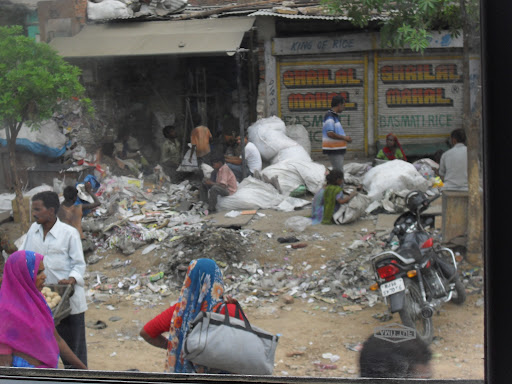
-There are tons of little retail shops throughout all the small but dense towns strewn across India. People gather around the streets lined with these shops, sometimes spilling out onto the highway (which is just a road like any other but sometimes sporting a median).
-The girl I ended up sitting next to on the bus was the same girl who I'd had to wait for for so long with the guide at the airport, the night before. I mentally forgave her on account of the British accent and all.
-There are many hill top temples and lone mountains along the way from Delhi to Jaipur. The terrain is savannah-like with less tall grass; the land visibly exhausted after surviving the majority of the intense Indian summer.
-Things were still "reminding me of slumdog." They were reminding my seat neighbor of slumdog as well. Must be a westerner first-time-to-India thing.
-I wouldn't be able to sleep while traveling through India during the day, just too excited about all that was going on around the road and outside the window.


Pictures:
-Blurred bus shot: could be a Greyhoud, could be a college STLF trip, could be a bus full of Europeans spending their summer in India.
-Garbage strewn area of a small town along the highway.
-Temple on a mountain.
-Temple on a hill.
-Highwayside town.
-Restaurant/nice rest area we stopped at that sold bottled Coke and Pepsi and trinkets, and was covered in European cellphone company Vodophone advertisements (a common building material around here).
-Grain bin, photoshop out the big hill behind it and it could be Iowa.

Monday, July 6, 2009

Wolfpack


Nine am sharp, I was told by the broken-armed airport greeter guide. Be in the hotel lobby and prepared for the six hour bus trip from Delhi to Jaipur by nine am. Sharp.

Mathias did not go into the hotel with me. Turns out, he was participating in a different program saving turtles or something in the mountains and would be staying in a different hotel meant for his fellow project mates. As a strange sort of happening, thirty four people had made the same decision as Mathias to participate in the Himachal volunteering program and only three had decided to go with the Kanjar Community volunteering program. And while I am certainly biased, I will say that I had personaly thought that working with discriminated and impoverished children in the desert is probably more hardcore than the yoga-lesson and tiger-sight-seeing loaded Himachal turtle program.

Relieved to escape our cramped car escourt, I was checked in and riding the 3x3 square foot elevator (with a bellhop and my stuff both uncomfortably pressed up against my sides) up to my room by 4:30am Indian time. As the twenty room Hotel le Heritage opts to utilize old fashioned circle locks and keys in place of card reading e-locks, the bellhop ruthlessly held the door buzzer and awaited whoever was inside to wake themselves up and open the door.

Thirty seconds or so later a bearded man opened the door in his underwear and let me in. It was Rick Devoss, of Council Bluffs, Iowa. Another guy, fully extending his arm to avoid getting out of bed, flipped on the light. His name was Magnus Andri. There was a strange sort of silent pause as the three of us (I the only with more than one clothing garment on) looked at each other, the bellhop, and the two single beds pushed side by side in the middle of the room, each individually trying to figure a solution to the inevitable conflict of the three dudes two beds shortage.


When I was in the second grade, I would walk on the painted lines of the LC playground with a friend just about every recess. Together, we would imagine battling monsters and finding nuclear codes to defeat criminal masterminds and all sorts of adventures. Although briefly drifting somewhat apart over the next decade or so, we had plenty of fun messing around on the same little league baseball team, the bench of our little kids' basketball team, at the endless middle school wrestling and high school track meets, basements of the Brads, and the college town bars around Iowa. That friend was Rick Devoss, who then stood before me at 4:40am in some random little hotel room in New Delhi, India. Within a week, we'd be team teaching math and English to a rowdy group of rural Indian children.


The only non-Iowan non-Indian in the room, Magnús Andri Pálsson was the six foot, blonde haired blue eyed guy (later: "What does a typical Icelander look like? Well you're looking at him") trying to explain to the bellhop the beds-to-males ratio problem he apparently wasn't noticing. Already in India for two weeks prior, the twenty five year old was able to settle for an extra blanket and pillow. Growing up obsessively watching American movies to rid himself of the 'terribly awful sounding' accent typical of Icelanders, the former-taxi-driver former-aluminum-smelter had found himself to be a born traveler after a six months backpack through South America. Finished with Europe, he figured to start his next continent with India. After watching his country's economy collapse (suffering massive banking crises) earlier in the year, Magnus boarded a plane, spent a few weeks in the mountainous north of India, and now found himself occupying the same bed as two travel weary Americans.

The three of us comprised the whole of the Kanjar Community Project volunteer staff.